It has been raining since breakfast. The park is out, your four-year-old is bouncing off the sofa and the toddler has started eyeing the bookshelf. Children aged 1 to 6 need to move, and a wet day does not change that. You do not need a big house or any special equipment. A cleared patch of floor about the size of a rug is enough for the games below. Each one takes a minute or two to set up, works across a range of ages and can stop the moment it stops being fun.
First, Make a Safe Space
Before any game, take two minutes to clear the floor. Push the coffee table to one side, pick up small toys and move chairs against the wall. Look for sharp corners at your child's head height and for anything that could slide, like a loose rug on a wooden floor.
A small room is fine, as long as the space is clear and nothing on it moves under a running foot. Run through this quick checklist each time:
- Bare feet or grippy socks, never plain socks on a smooth floor.
- A non-slip surface: carpet, a rug that stays put or a yoga mat.
- Nothing to trip over, with toys, cables and bags out of the way.
- Water to drink nearby, and a window open a little if the room gets warm.
- Toddlers within arm's reach, especially near furniture they could climb.
Freeze Dance and Its Cousins
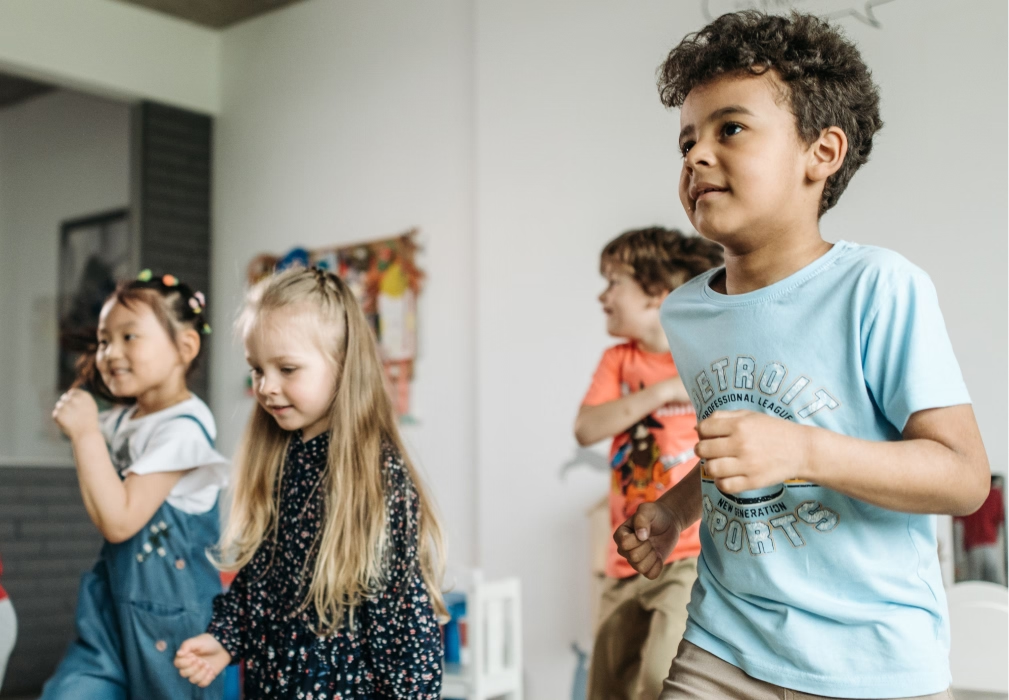
Freeze dance is a classic for good reason. Put on some music and everyone dances. When you pause it, everyone freezes like a statue until it starts again. It needs no set-up, and it gives children practice with listening, stopping their bodies on purpose and getting going again.
For under 3s, keep it simple. Dance together holding hands and freeze together with a big "stop!" Expect wobbly freezes and lots of giggling. For older children, add a rule to each freeze: freeze like a tree, freeze on one leg, freeze very low to the ground, freeze with your hands on your head. Let them take turns being in charge of the music.
Change the tempo as well. Play something fast, then something slow and quiet, and ask your child to move the way the music sounds. "Is this music stompy or tiptoe?" There is no wrong answer. With siblings of different ages, the younger one can be the one who shouts "freeze", which keeps small bodies out of the path of bigger, faster ones.
Animal Walks Across the Room
Animal walks turn a short stretch of floor into a whole zoo. Put a cushion at each end of the room as the start and the finish. Call out an animal, then cross the room together moving like it. Older children can call the animals for you.
Talk about each animal before you set off. "Is a mouse fast or slow? Loud or quiet?" Many four and five-year-olds love inventing new animals and teaching you how they move. If energy is running high, finish with a slow one. A sleepy tortoise is a very welcome animal at the end of a wet afternoon. Here are six to start with:
- Bear walk: hands and feet on the floor, bottom in the air, moving slowly.
- Frog jumps: squat low, then jump forward. For under 2s, hold both hands and bounce together instead.
- Crab walk: sit with hands behind you, lift your bottom and walk. Best for ages 4 and up.
- Penguin waddle: feet close together, arms by your sides, tiny steps.
- Snake slither: lie on your tummy and pull yourself along with your arms.
- Elephant stomp: big, slow, heavy steps with one arm swinging as a trunk.
Balance Paths From What You Have
A balance path is a route across the floor that your child follows carefully. Stick a line or a zigzag of painter's tape on the floor, lay a folded blanket down as a narrow bridge, or set out a few cushions to step across. Masking tape on carpet works too and peels off easily afterward.
Start by walking the line forward. Then try it sideways, on tiptoes, very slowly or carrying a soft toy on one flat hand. Under 2s can walk along it holding your hand, or step from one cushion to the next with help. Five and six-year-olds can try walking heel to toe, walking backward or hopping along a short stretch.
Keep the whole path at floor level. Balancing on the floor gives children the same practice as balancing on the sofa, without the drop. Cushions slide on smooth floors, so only use them on carpet or a rug that stays put.
Safety Notes and When to Stop
A few rules are worth keeping every time. Stay close, within arm's reach for under 3s. Keep all poses simple: no headstands, handstands, shoulder stands or deep backbends, and no holding the breath. Never push a child further into a stretch than they go on their own.
Stop when anything hurts, when your child seems very tired or upset, or when the game turns wild and people start crashing into each other. Ending on a calm note helps everyone. Lie on the floor together and take a few slow breaths: smell an imaginary flower, then blow out an imaginary candle.
If your child has additional needs or a health condition that affects how they move, go slowly, follow their lead and ask their doctor or therapist what suits them. And if the rainy day ends with only five minutes of dancing before everyone wants a snack, that still counts.
Takeaway. On a wet day, a clear patch of floor and a little music are all you need. Keep it short and close to the ground, and finish with something slow.
This article is general play education for parents. Always supervise children during play. Read the safety notice.